

Winning the Attention War: Why Sustainable Strategies Need to Speak Human
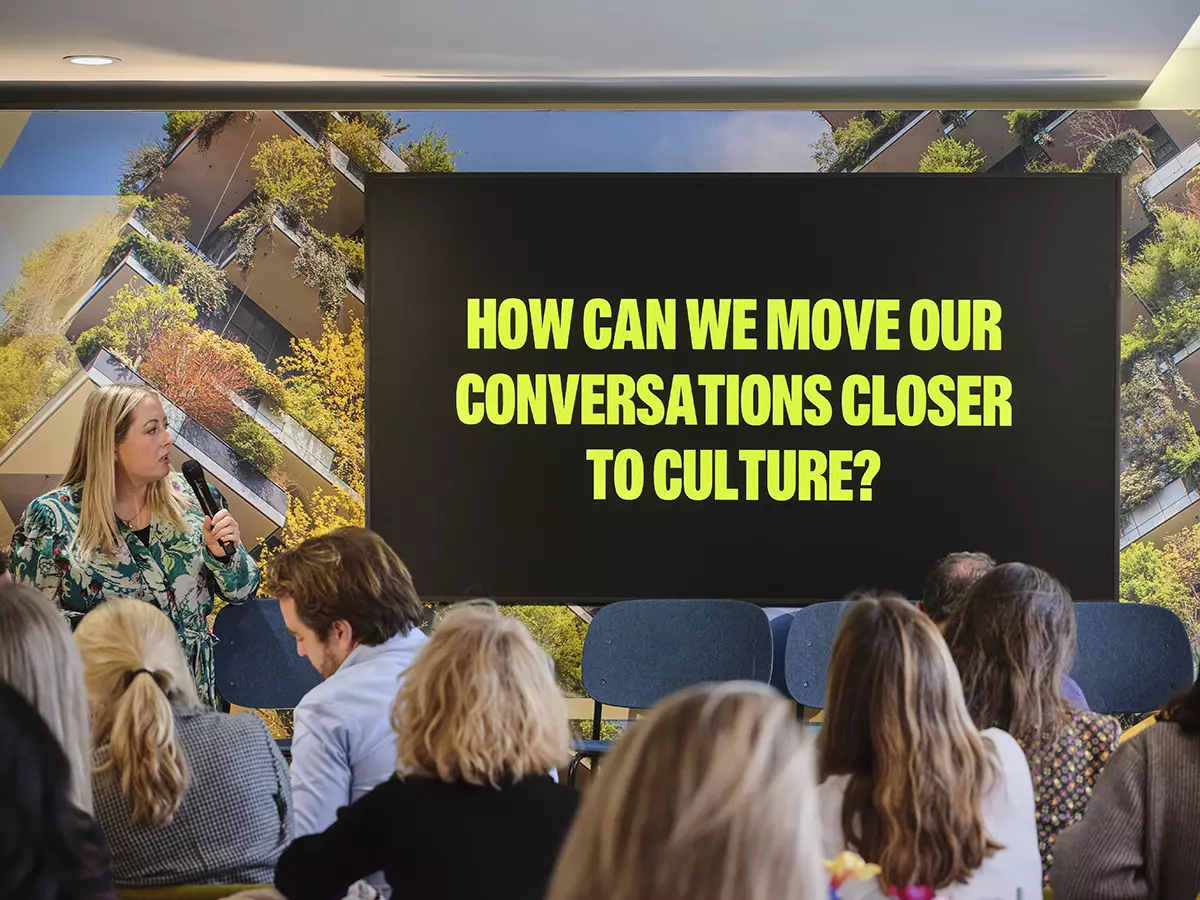
We are in an attention economy. Attention is a scarce and finite resource that should be treated as such. This observation, offered by Katie Gilbert of M&C Saatchi during an InTent workshop in Davos last January, captures a central paradox facing the sustainability transition. Survey data tells us that 80% of people care about climate and nature.[1] Public concern remains stable. Trust in science holds firm.[2] Yet behaviours aren’t changing at scale. Headlines aren’t shifting. Political momentum stalls. The climate and nature community often interprets this as a communication failure. But is it, really?
The Misinformation Mirage
Yes, sustainability misinformation is real and growing. Nature-positive strategies are competing for attention within algorithmic systems designed to privilege fast-moving, reactive content – the same dynamics in which climate denialism and nationalist populism thrive. And if your nature-positive strategy can’t cut through that algorithm, it doesn’t matter how scientifically sound it is. You’ve already lost.
But before spiraling into defensiveness, consider the counter-evidence advanced by Johan Rockström, Director of the Potsdam Institute for Climate Impact Research. Yale polling data shows public concern about climate change remains stable.[3] Trust in science hasn’t collapsed. The noise is louder in politics than among citizens. There’s a mismatch between public maturity and political leadership – but the public remains committed to the cause.
More importantly, Rockström argues that the backlash isn’t proof we’re losing. It’s proof the sustainability transition has become threatening to incumbents.
Every historical transition – slavery abolition or women’s voting rights – faced peak resistance when it got serious. When vested interests recognise they’re genuinely threatened, the kickbacks intensify. The current wave of misinformation isn’t a sign that the sustainability movement is weak. It’s a sign that it’s gaining widespread traction.Yet, it’s not cutting through the noise yet.
We’re coming from a position of force, not from a position of weakness. This is the final round of the transition phase.
The real problem is, we ask for attention before earning it.
For Steve Walls, co-founder of Climate Basecamp and a veteran of advertising, “Climate communication drips with disdain for the people we’re talking to.” Indeed, the sustainability community tends to treat communication as extraction. We ask for pledges. We demand behaviours change. We instruct people to sort their recycling into a fifth bin. The implicit message is always the same: “You people don’t get it. Let us educate you.”
This creates what psychologists call reactance – a defensive response triggered when someone perceives a threat to their autonomy. Tell someone they’re wrong, judge their choices, imply moral superiority, and watch how quickly they harden against you. Consider hunters. Many of them understand climate change intimately – they see shifts in migration patterns, breeding seasons, habitat quality. But they’re stereotyped and excluded from climate conversations.
According to Zelda Chauvet, director of Our Frame, “We don’t have a knowledge problem. We have a meaning problem.” Messages don’t travel through neutral spaces. They pass through identity, emotion, social norms, and cognitive biases. Once public, they no longer belong to the sender. Audiences reconstruct meaning according to their own social and political realities. And when the premise of a message is “you’re doing it wrong,” people don’t reconstruct – they reject. When it begins with “we see you,” they don’t push back, they engage.
Culture and Empathy-Driven communication
If attention is the currency of change, and empathy is the vehicle, what does effective communication look like in practice? It starts with a fundamental shift: stop starting with “What do we want to say?” and start with “What cultural trends can we attach to?”
According to Katie Gilbert of M&C Saatchi, in 2026, three major cultural signals are emerging: anti-algorithm sentiment (desire for autonomy and authenticity), extended midlife (people asking “How do I live well for longer?”), and the affection deficit (craving for genuine connection). Sustainability messages that speak to these underlying currents will cut through. Messages that lecture about planetary boundaries won’t.
For example, it is estimated that the upcoming FIFA World Cup 2026 will see 10 of 16 venues face extreme weather disruption.[4] Research shows that 14 of the 16 host locations already exceed safe-play heat stress thresholds for athletes.[5] This is a predictable cultural moment – but how many nature-positive organisations are preparing reactive content to capitalise on it? The pattern is clear: when you attach sustainability to what people already care about – sports, food, longevity – you earn attention. When you treat it as a separate moral obligation, you lose.
Now, to the harder part: empathy. It’s the discipline of understanding your audience’s actual motivations, fears, and constraints. And it’s the driver of what business strategists call user-centric design.
The only way to reach the movable middle is not to pelt them with data, but to open their minds and hearts in other ways.
This isn’t about abandoning facts. It’s about recognising that facts dressed up as judgment don’t travel. Facts dressed up as entertainment, service, or solidarity do. Formula milk brands learned this years ago. “Breast is best” messaging made mothers feel guilty and alienated. “Fed is best” acknowledged real constraints and built trust. The latter won market share not because it was scientifically weaker, but because it was emotionally intelligent.
The reframe is simple but profound: move from “What do we want from you?” to “What can we do for you?” From moral authority to generous service. Brands that reframe sustainability as problem-solving for real people – not planetary abstractions – build loyalty. The shift from “lower your carbon footprint” to “let’s build a forest for the community” is subtle but transformative. One extracts (demanding individual sacrifice). The other generates (offering collective benefits).
What Decision-Makers Can Do
For business leaders navigating the attention economy, here are four concrete actions:
1. Audit your communications for extraction versus generosity
Review your sustainability messaging. Are you asking or offering? Lecturing or listening? Count how many times you use “must,” “should,” or “need to” versus “can,” “could,” or “together.” The ratio will tell you whether you’re extracting compliance or inviting partnership.
2. Adopt a culture-first distribution strategy
Embed your message into a cultural calendar. You can map the year’s predictable moments that can be relevant to your strategy or prepare reactive content that attaches your nature-positive work to what people already care about. Work with advertising and creative partners who understand cultural and algorithmic attention.
3. Build empathy into your stakeholder engagement
Don’t design messages only for people like you. Commit to designing for people who distrust you.
- Test your communications with audiences outside your bubble.
- Hire communicators from non-traditional backgrounds – people who’ve lived the identities you’re trying to reach.
- Commission ethnographic research, not just surveys. Understand the fears behind resistance, not just the demographics.
This is about building genuine curiosity about why someone believes what they believe. Not as a prelude to correcting them, but as an act of respect. That’s user-centric design. That’s how you build trust.
4. Act with confidence
Rockström’s reminder matters: the backlash is proof the transition is real. When resistance peaks, that’s when change accelerates. Don’t retreat. Don’t soften your commitments in response to political noise. Double down. The public maturity is there. The science is overwhelming. The gap is in political and corporate leadership.
The sustainability transition is already happening. Public concern is stable. Trust in science holds. In an attention economy, crafted communication that cuts through noise and validates sustainable strategies and leadership is not glossy vanity. Earning attention – via empathic, creative, and authentic communication – is an integral part on how we shift systems, making sustainable strategies not only morally or economically relevant, but culturally inevitable.
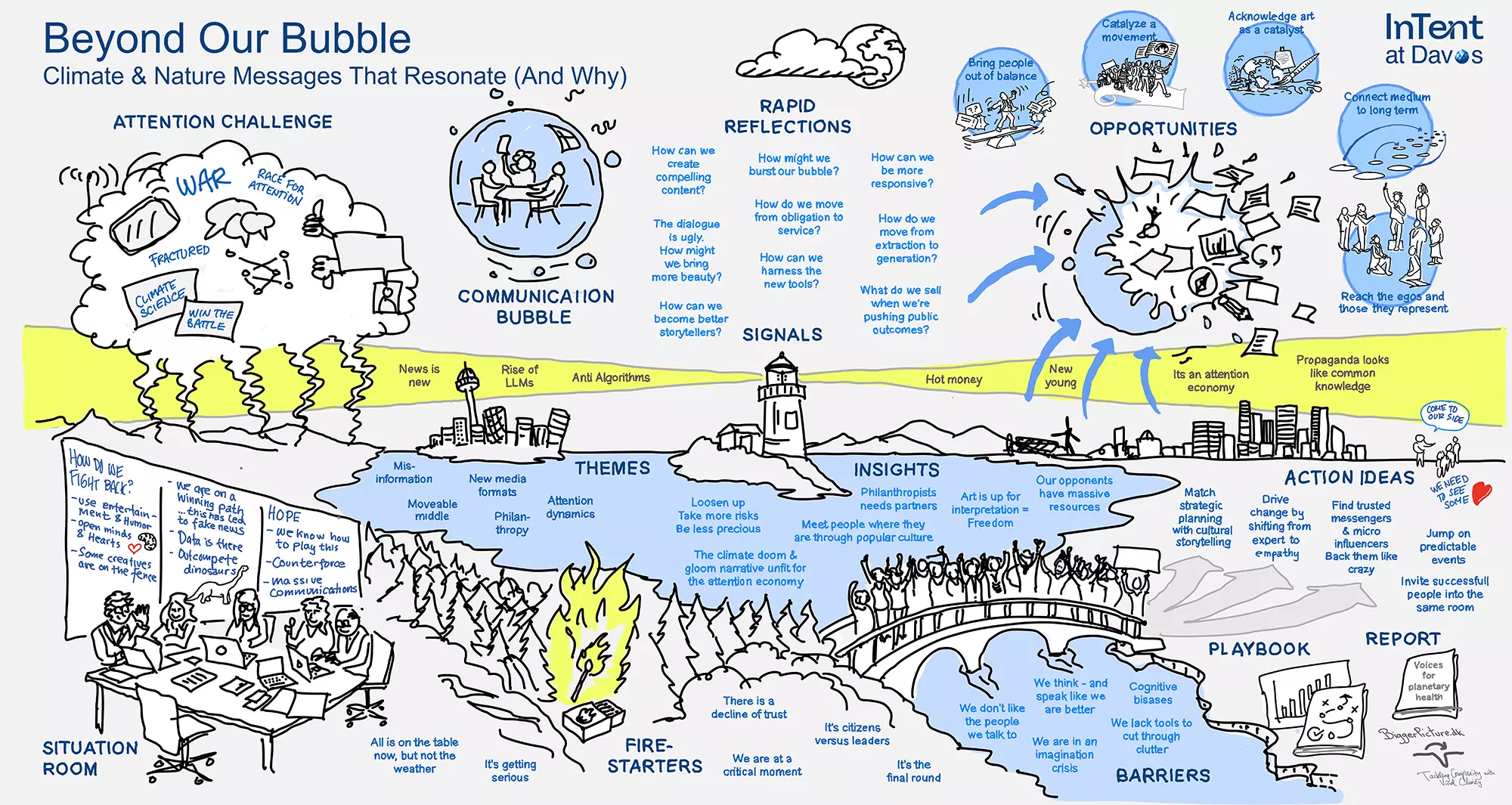
Visual map designed by Ole Qvist-Sørensen, BiggerPicture.dk following the “Beyond Our Bubble” session at Davos 2026, diving into how climate and nature messages can cut through noise and earn genuine attention.
[1]: The Peoples’ Climate Vote 2024, conducted by UNDP and University of Oxford across 77 countries with 73,000 respondents, found that 80% of people globally want their governments to take stronger action on climate change. Source: UNDP Peoples’ Climate Vote 2024 and University of Oxford coverage
[2]: Yale Program on Climate Change Communication’s “Climate Change in the American Mind” surveys (2008-2024) show stable public concern about climate change and consistent trust in science. The Fall 2024 survey found 72% of Americans believe global warming is happening. Source: Yale Climate Opinion Maps 2024
[3]: Yale Climate Change in the American Mind surveys show that 72% of Americans think global warming is happening, with more than half (54%) of registered voters believing it should be a high or very high priority for government. Public trust in climate science remains stable despite political noise. Source: Yale CCAM Fall 2024 Report
[4]: Multiple studies warn of extreme heat risk at 2026 FIFA World Cup venues. The “Pitches in Peril” report by Football for Future, Common Goal, and Jupiter Intelligence found that 14 of 16 venues already exceed safe-play thresholds for extreme heat, flooding, and unplayable conditions. Source: Earth.Org coverage
[5]: Research published in Scientific Reports found that 10 of 16 FIFA World Cup 2026 stadiums face “very high risk of experiencing extreme heat stress conditions” with wet bulb globe temperatures (WBGT) exceeding 28°C, the threshold for drinks breaks. Venues in Houston, Dallas, Atlanta, Miami, Kansas City, and Monterrey face particularly high risk. Additional research in PMC confirms 14 of 16 host locations exceed WBGT thresholds. Sources: Scientific Reports study via Eos, PMC research paper, and TIME coverage


Speakers


Partners


Stay updated
Register to InTent newsletter to stay informed on our programmes, events and latest news