

What if blended finance could contribute to safeguarding tropical forests?
When consensus diplomacy stalls and aid budgets tighten, new “workarounds” are emerging. The Tropical Forest Forever Facility (TFFF) is an ambitious illustration: a long-duration financial mechanism designed to pay tropical forest countries – and earmark a share for Indigenous Peoples and local communities – for safeguarding tropical forests.
TFFF, in a nutshell
Last January, in Davos, the choreography of multilateralism felt subtly different. International institutions remain central to global cooperation, and they continue to convene, negotiate and set direction. But alongside these established frameworks, new forms of collective action are emerging: smaller, faster coalitions of governments, investors and institutions testing ways to move from dialogue to delivery without waiting for universal consensus. This evolution is particularly visible in the environmental space, where the urgency of climate and nature risks is pushing actors to experiment with complementary pathways for action.
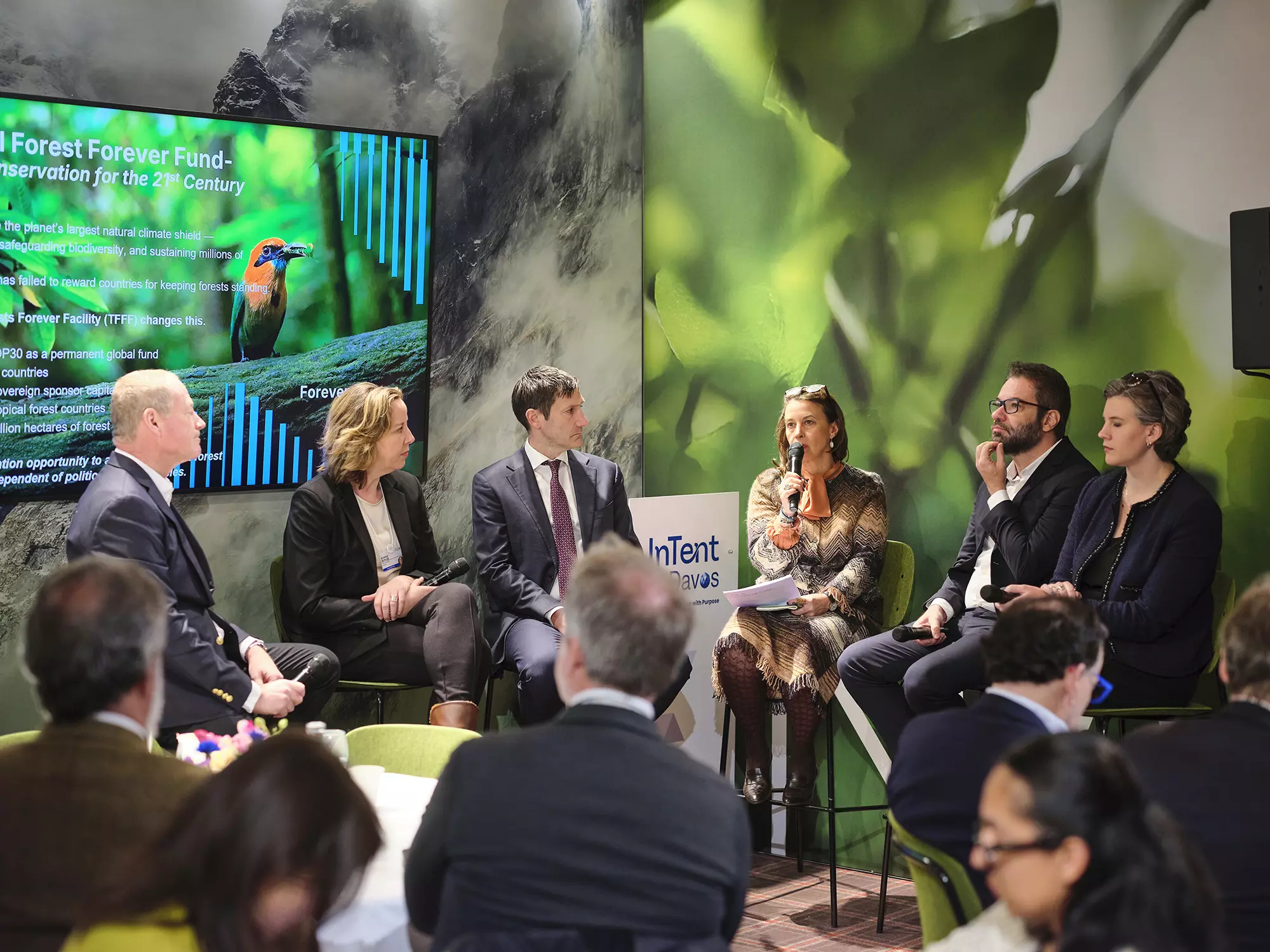
In a Davos conversation hosted by InTent, sustainability expert Xenia zu Hohenlohe put it bluntly: “We’re not paying for the wildlife. We’re not paying for the habitat that it provides to all of us… that is really a market failure.” Indeed, in practice, climate stability, functioning ecosystems, rainfall patterns and biodiversity behave like global public goods – benefits shared by all, financed reliably by few. The result is a familiar mismatch: collective dependence, fragmented responsibility. Into that gap, the TFFF is now trying to insert something different.
What is TFFF
The Tropical Forest Forever Facility is an attempt to build an endowment-like, results-based payment mechanism for tropical forests – structured to be durable over time, and to rely less on donor replenishments.
In simple terms: TFFF aims to raise a pool of junior (“sponsor”) capital – targeted at US$25 billion – that can absorb first losses and de-risk the wider structure. With that foundation, the facility is designed to mobilize up to US$100 billion in bond issuance over time, bringing the total ambition to roughly US$125 billion.
Public communications indicate that more than US$6.7 billion has already been pledged in support of the facility, with a stated goal of reaching US$10 billion by 2026, on the pathway to US$25 billion in junior capital.
While it is still at its premise, TFFF signals that climate and nature cooperation may be expanding beyond consensus-based negotiations: with new coalitions that can move faster, backed by patient capital that can survive political cycles.
Multilateral fatigue, meet “coalitions of the willing”
At the dawn of 2026, the traditional mode of multilateralism – negotiations, uncertain replenishments, and stop-start political will – is colliding with today’s reality: tighter budgets, polarized politics, and competing crises that push nature down the priority list just when risks are becoming more physical, more local, and more expensive.
Last November, the intention of the Government of Brazil’s – the initiative’s architect – has been to treat COP30 not only as a negotiation moment but as a forcing function: gather a group of willing governments and partners, set a clear structure, and build momentum through a “domino effect” of early backers. This is, in essence, an attempt to operationalize a new kind of cooperation: not a replacement for multilateralism, but a workaround when it stalls – coalitions that act first, prove feasibility, and widen participation as credibility grows.
That approach raises important considerations. Coalitions can move more quickly, but they also require careful design to ensure openness, legitimacy and trust over time. As initiatives like these mature, attention to governance – who participates, how decisions are taken, and how accountability is ensured –will be as important as the scale of the capital they mobilise.
Patient capital in an impatient world
If the “coalition” logic explains the politics, “patient capital” explains the financial bet. TFFF is built around virtues the market rarely celebrates: duration, discipline, and governance.
The structure is familiar to institutional finance but unusual in conservation at this scale: sponsor/junior capital is designed to take first loss and lower risk; senior investors participate through bonds at market-like terms; and the residual return is used for conservation payments.
Why does that matter? Because it reframes nature finance away from ad hoc aid toward long-lived financial security. Supporters argue that forests need what infrastructure needs: predictable funding over decades.
As advanced by Christopher Mouravieff-Apostol– Equity Partner, Banque Pictet & Cie SA – this is also why the instrument is intellectually attractive to long-horizon allocators – sovereigns, foundations, or family capital – who are increasingly looking for ways to align capital with outcomes without treating every solution as a grant (see interview below). TFFF’s own description explicitly positions the mechanism as long-term and reliable.
But patient capital is not just a funding preference; it is a cultural challenge. It demands credible institutions, clear rules, and a tolerance for slow compounding in a world optimized for quarterly reporting, that may be TFFF’s hardest test.
Governance, measurement, and who gets paid
First, eligibility and monitoring. One widely cited design feature is a performance threshold: TFFF is described as paying countries that keep tropical deforestation below 0.5% per year, using geospatial monitoring. This is appealing because it is measurable and comparable across countries. It is also blunt: ecosystems, enforcement capacity, and land politics vary from one jurisdiction to thr next, and any single threshold will create controversy.
Second, fund recipients. The mechanism is structured around payments to eligible tropical forest countries, but it also includes a stated floor: at least 20% of disbursements should be allocated to Indigenous Peoples and Local Communities (IPLCs). That 20% floor has been presented as a meaningful, if imperfect, recognition of stewardship.
Third, no percentage and no satellite system can substitute for good governance. The facility’s credibility will rest on whether safeguards are enforced, transparency is effective, and funds actually reach stewards in ways that strengthen rights rather than undermine them.
A humble proposition
It would be naive to declare that blended finance will “save tropical forests.” At this stage, Tropical Forest Forever Facility is an experiment.
But if successful it could set a precedent for a new phase of cooperation: coalitions that deliver, backed by patient capital, financing global public goods through mechanisms designed to endure. It might demonstrate that results-based payments can be scaled without relying entirely on uncertain aid cycles, and that long-horizon investors can contribute beyond philanthropy.
In that sense, TFFF signals a potential shift in how conservation cooperation is conceived. It represents a form of credible experimentation at a moment that urgently calls for it. When multilateralism is under strain, testing new structures – carefully, transparently, and with humility – may be the most responsible form of ambition.


Speakers


Partners

Stay updated
Register to InTent newsletter to stay informed on our programmes, events and latest news