

Trust as Infrastructure: Business' Next Strategic Imperative
From the Jeffrey Epstein cover-up in the United States to the UK’s maternity care crisis at the National Health Service, a crisis of trust in institutions is rolling like a tsunami over our societies. We’re far past the point where the trust crisis is endangering the pillars that keep our society standing: they’re crumbling. But why is this so, and what can we do about it? An article by Peter Vanham, Co-author, The New Nature of Business.
Trust is the invisible superglue of our societies. Interpersonal trust, on one hand, is a lubricant in social relations, dixit Nobel Prize winner Kenneth Arrow. In societies where trust and social bonds are strong, people live happier lives. And trust in institutions, on the other hand, enables low-cost transactions, allows for specialisation, and contributes to economic development.
For all these benefits, there is a major issue with trust today: it is in dangerously short supply. Trust in institutions is falling around the world, and in the world’s largest economy, even interpersonal trust remains near its all-time low. This loss of trust should worry us, as it risks spiraling into crises, a breakdown in international relations, and, in extreme cases, conflict.
Data from the OECD illustrates the scale of that deficit. In its trust survey conducted in late 2023, more people reported low or no trust in their national government (44%) than high or moderately high trust (39%). When institutional trust thins, societies pay twice: everyday cooperation becomes more adversarial and costly, and the rules-based order – domestically and internationally – loses legitimacy precisely when coordination is most urgently needed.
As a result, for many people today, everywhere they look, there is cause for anxiety, scepticism, and indeed mistrust. As the latest Edelman Trust Barometer put it: over the past five years, inflation, the rise in online misinformation, the COVID-19 pandemic, trade wars, and the growing use of generative AI all negatively affected people’s trust in each other and institutions.
This is not a recent phenomenon. Institutional trust has been eroding over years. In the United States, Sergei Guriev, the dean of London Business School, argued in an InTent session in Davos this past January, the first big shock in trust came as early as the 2000s, “when a lot of workers lost their jobs because of globalisation, and the government did not invest in supporting workers who were affected”.
In Europe, meanwhile, the big shock to institutional trust was during the Great Recession of 2008 and the subsequent sovereign debt crisis in Europe in 2010-2011.
When people saw that suddenly the system is shocked due to mismanagement of the financial system, failures of regulators, they also started to question the very system, and that resulted in the growth of populism
And then, of course, the impacts from social media, digital misinformation and artificial intelligence were yet to hit. Social media, notably, caused a barrage of mistrust in recent years.
Research by Sergei Guriev and colleagues (Guriev et al., 2021) shows that social-media and digital platforms systematically reward outrage, negativity, and polarisation, with studies demonstrating that the spread of 3G internet explains about half of the recent rise of populism in Europe (Brady et al., 2021). This is not accidental; it is embedded in incentive structures designed to maximise attention. The result is fragmented realities, rapid spread of misinformation, and shrinking space for nuance or correction.
Social media propagates narrow or false information and different sets of facts to subgroups in society. We have no common ground any more. It is corroding understanding.
As for artificial intelligence, Sebastian Mallaby argued in Davos, the rise of so-called AI “open-weight models” has raised the stakes regarding misinformation even more. Open-weight models can be adapted by anyone, meaning they bring big opportunities – and even bigger risks.
The convergence of these forces – globalisation shocks, financial crises, social media, and AI – has created a perfect storm of institutional distrust. In another era, the response to declining institutional trust within societies was to build guardrails at the international level, with international multilateral organisations (IOs) as their backstop. It is what happened after World War II, when the UN system was set up to prevent a breakdown in trust from leading to civil or interstate war and conflict.
A great tragedy of today’s breakdown in institutional trust is that IOs and NGOs are themselves engulfed by it. The Red Cross, to name one of the oldest and historically most trusted international institutions, is today observing “an erosion of respect for international humanitarian law,” its Vice Chair Gilles Carbonier said.
The organisation is affected very directly by this loss of trust and respect. As proof, its website is full of FAQs addressing the misinformation that exists about it, and dozens of its staff were killed in the line of duty. Other IOs, from the WHO to the UNHCR, are increasingly distrusted, with some of the fuel for this distrust coming from high-profile governments.
Overall, no institution today escapes the mistrust trend, including companies. Even though the Edelman’s Trust Barometer ranks them consistently as the most highly trusted institutions in society, some distrust crises today directly involve companies, from food to pharma, and from engineering companies to consultants.
Getting out of our current trust crisis, then, starts by questioning our own roles in it, whether we’re companies, NGOs, individuals, or governments. “You look into your own court and say: what is going wrong and what do we have to improve?” Severin Schwan, Chair of Roche, said in the Davos session.
The best advice I ever got in that regard came from Jean-François van Boxmeer, who at the time was CEO of beer maker Heineken. Heineken was proud of its global footprint, he told me. But it also made mistakes, which caused grief, and hurt people’s trust in the company. What you need to do then, is to “admit, apologise, and repair” (accountability, consistency, and repair).
The second way to rebuild trust is to make it the central pillar of multilateral organisations. If lack of trust leads to resentment, dysfunction, conflict, and war, then what better feature than being trustworthy can international institutions and NGOs have?
One organisation that “got” this is the World Health Organisation. For all the public health benefits it worked on, the organisation until the early 2020s also had a workplace culture that fostered abuse of power and led to dozens of claims of exploitation and sexual harassment, both inside and outside the organisation. This was no basis for trust.
The WHO was faced with this crisis just as COVID hit. But for all the challenges and strains managing a global pandemic put on the organisation, the WHO realised it needed to take radical steps to improve its workplace culture at the very same time, Dr Tedros Ghebreyesus, the WHO’s director-general, told me at the time.
The organisation hired an outside agency to investigate the worst claims, earmarked $25 million in its budget and 350 full-time or part-time employees to help prevent harassment and assist victims, and perhaps most importantly: it was radically transparent about its findings, including in dismissing perpetrators. It was a much better basis for trust.
If distrust is systemic, we need to rethink our international trust architecture. Of course, with a “rival-driven, non-trust-based” government in the US, such an entente is hard to imagine. Recent analysis published by The Centre for Economic Policy Research (CEPR) suggests that US policy directions—including sweeping tariffs, breaks in global alliances, and risks to multilateral institutions—are likely to heighten economic uncertainty and weaken the rules-based order. But an entente amongst some of the world’s so-called “middle powers” is conceivable. Canadian Prime Minister Mark Carney in Davos argued exactly for such coalitions of the willing. These middle powers – countries such as Canada, Australia, South Korea, and several European nations – possess significant economic and diplomatic capacity whilst being more vulnerable than great powers to global instability. By coordinating their approaches to trade, security, and international governance, they could create meaningful alternatives to a purely bilateral great-power framework.
And they could succeed. Despite widespread distrust in international institutions, let’s remember that their primary mission – to protect peace and the world commons – remains urgently relevant. How to fulfill this mission is the bigger challenge. Coalitions of the willing open tangible alternatives to global multilateralism to protect peace and the world commons.
For business, this opens space not only to participate, but to help shape cooperation. It will benefit them just as much as it will the societies they operate in. As the World Bank has repeatedly shown, fragile institutions and low legitimacy are powerful predictors of instability – and the opposite is also true.
Restoring trust will be slow, contested, and imperfect. But the alternative – allowing institutional trust to continue eroding – is far costlier. For business, the message is clear: stability is not a backdrop to economic activity. It is a precondition that must be actively built – by rebuilding trust in themselves, in each other, and in the systems we all depend on.

Visual map designed by Ole Qvist-Sørensen, BiggerPicture.dk following the “Restoring Trust: Strengthening Cooperation and Building the Conditions for Enduring Peace” session at Davos 2026, exploring how business can move from intent to action — helping to restore trust, strengthen cooperation, and build the conditions for enduring peace.
Brady, W.J., McLoughlin, K., Doan, T.N., & Crockett, M.J. (2021). How social learning amplifies moral outrage expression in online social networks. Science Advances, 7(33), eabe5641.
Guriev, S., Melnikov, N., & Zhuravskaya, E. (2021). 3G Internet and confidence in government. Quarterly Journal of Economics, 136(4), 2533-2613.
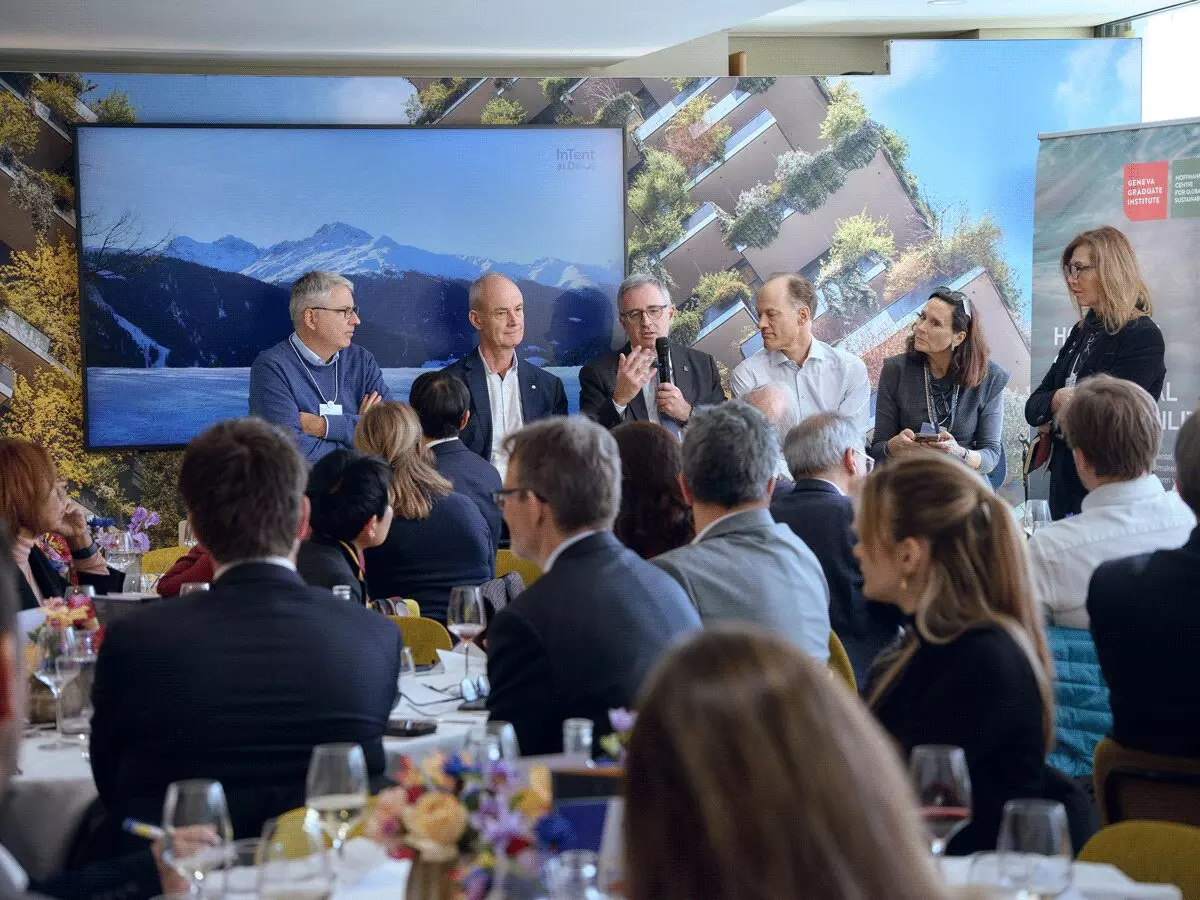
This piece draws on insights from the “Restoring Trust: Strengthening Cooperation and Building the Conditions for Enduring Peace” session at InTent at Davos 2026, co-moderated by Béatrice Weder di Mauro, Chair, Hoffmann Centre for Global Sustainability, The Graduate Institute with contributions from Sandrine-Dixson-Declève, Honorary President, The Club of Rome, Sergei Guriev, Dean, London Business School, UK, Sebastian Mallaby, Paul A Volker Senior Fellow US Council of Foreign Relations, Martin Sandbu, European Economic Commentator, FT, Severin Schwan, Chairman of the Board of Directors, Roche AG, Switzerland.
Author
Business journalist, author, and researcher, Peter Vanham writes about the global economy and the people who shape it, as well as concepts such as stakeholder capitalism and sustainability. As an author, his books include The New Nature of Business (with Andre Hoffmann, 2024). As a journalist, Peter works as Editorial Director at Fortune, and is one of the main contributors to Fortune’s CEO Daily flagship newsletter.
Stay updated
Register to InTent newsletter to stay informed on our programmes, events and latest news