

Patient Capital, Systemic Change: The Emerging Role of Business Families in rewiring the economy
There is a particular kind of infrastructure that we only notice when it strains. Trust enables markets to function. Shared standards allow competitors to coordinate. Ecosystems regulate the rainfall that feeds agriculture across entire regions. These foundations are so embedded in our daily commerce and cooperation that only when these infrastructures weaken do they become visible. We see how fundamental they are in the moment a supply chain fractures, a multilateral agreement collapses, or a river runs dry.
We are at such a time where these infrastructures become visible. News of geopolitical fractures, economic volatility, security fragmentation are being published everyday, all around the world. Yet beneath those headlines, the structural foundations of markets and cooperation are quietly being reassessed — and, in some places, quietly being rebuilt.
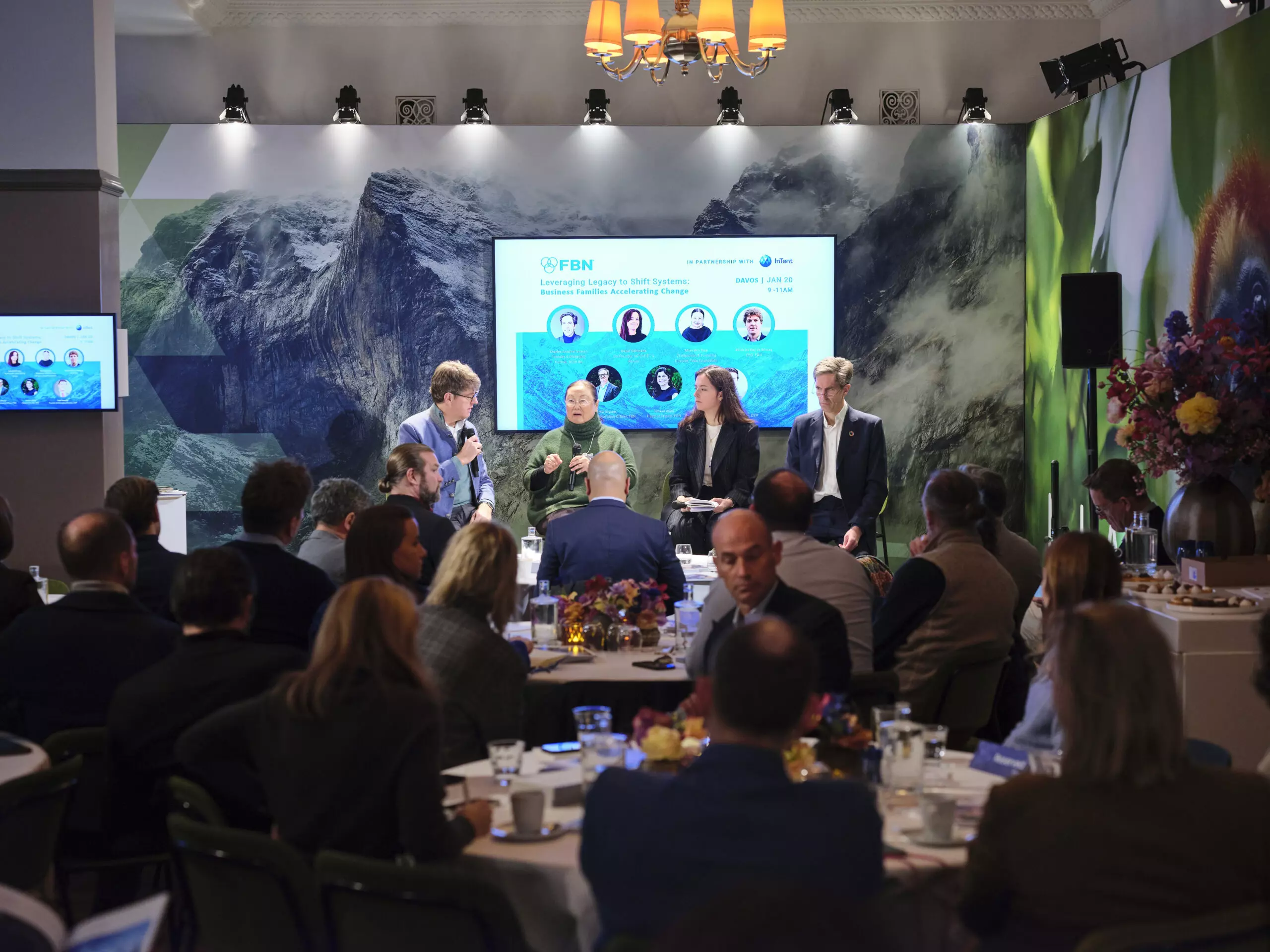
One of the conversations convened by InTent at Davos in January 2026 asked a deceptively simple question: who, exactly, are actors well- positioned to do that rebuilding? The answer that emerged was not the usual cast of listed multinationals or intergovernmental bodies. It was a category of actor that has, until recently, operated largely below the radar of the systemic change debate: business-owning families and private wealth holders.
The Hidden Asset
Family businesses are a backbone of the global economy. Research from McKinsey suggests they contribute over 70 per cent of global GDP; the 500 largest alone generate revenues equivalent to the world’s third-largest economy, according to the 2025 EY and University of St. Gallen Global Family Business Index. They account for an estimated 60 per cent of global employment. And yet, in the sustainability conversation, they have rarely occupied centre stage – partly because many operate privately and quietly, and partly because the dominant narrative has long focused on listed corporations and their disclosure obligations.
The Family Business Network (FBN), a global not-for-profit foundation representing 5,000 families across 65 countries, has spent the past decade arguing that this invisibility is a missed opportunity – for the families themselves, and for the systems they are embedded in.
Many people think family businesses are 70 per cent of the problem. At FBN, we believe they can be 70 per cent of the solution.
The structural argument is straightforward. Business-owning families think in generations, not quarters. To build a successful business across multiple generations requires building and maintaining trust – within the family, with employees, with communities, with institutions. In a world suffering from a deep and documented erosion of institutional trust, that competency is not a soft virtue. It is a structural advantage.
It is also, increasingly, a responsibility. The same structural features that make family businesses potential engines of long-term stewardship – privacy, concentrated control, multi-generational networks, and access to institutions – can also enable the perpetuation of harm at scale, shielded from the public accountability that listed corporations face. The structural position of family businesses creates unusual leverage – for good or for ill – and that the difference lies in whether that leverage is exercised with genuine accountability or merely with good intentions.
What distinguishes the actors described in this piece is not their wealth. It is the deliberate choice to subject that wealth – and themselves – to genuine accountability. Indeed,trust is not rebuilt through rhetoric. It requires admission of mistakes, consistent accountability, and transparency. Business families who wish to play a credible role in the current moment will need to be honest about their own legacies – including the extractive industries, the philanthropic dependencies, and the generational hierarchies that some of them are still navigating. The opportunity is real. So is the work.
From Philanthropy to Polycapital
For generations, the primary expression of family values beyond the business itself was philanthropy. Donations to conservation organisations, hospitals, universities, and cultural institutions. This model produced genuine good. But it also produced dependency – conservation NGOs structured around donor funding rather than systemic change, and families whose impact remained, structurally, a footnote to their economic footprint.
The shift now underway is from philanthropy as the primary lever to what the Centre for Sustainable Finance and Private Wealth (CSP), calls a multi-capital approach. Their framework identifies four distinct types of capital that wealthy individuals and families can accumulate and deploy: economic capital (monetary and non-monetary assets), social capital (access to and trust within communities), symbolic capital (reputation and the ability to lend credibility to causes), and cultural capital (knowledge, expertise, and lived experience).
The insight is that most families have been deploying these levers in silos – philanthropic money here, business assets there, investment capital somewhere else, voice and advocacy largely untapped. The real opportunity lies in combining them strategically, as a unified architecture for change.
A concrete example illustrates the difference. In the aftermath of COVID-19, a group of Indian business families confronted the crisis facing the country’s hundreds of millions of informal migrant workers – workers who had lost their livelihoods and, in many cases, their lives, overnight. These families did not simply write a cheque. They used philanthropic capital to seed an initiative called the Social Compact; business leverage to spread standards through their supply chains; and advocacy voice to bring other families on board. Within a few years, the initiative had improved conditions for over 300,000 workers – and the ambition was set at one million. This is not philanthropy. This is architecture.
This kind of multi-lever, integrated approach is what systemic change requires. Business families, it turns out, already have the toolkit. The question is whether they deploy it intentionally for good or leave its potential largely untapped.
Three Portraits of the Shift in Practice
Abstract argument only carries so far. The more revealing evidence comes from the individuals navigating this shift in practice.
Mary Ann Tsao, Chairwoman of the Tsao Family Foundation and Singapore-based shipping heir, describes a journey that began with a simple decision: the four siblings would not divide the family’s assets. They would manage them collectively, with a shared purpose. What followed was years of difficult work – learning to communicate, finding common values, and ultimately reorienting an entire portfolio away from extractive industries. Crucially, the family chose not to exit shipping – their core legacy business – but to transform it, investing heavily in environmental standards and ocean health. “You can’t just say get out and let somebody else do the hard work,” Mary Ann Tsao said. Legacy, in her framing, is not a burden to be managed but a responsibility to be discharged with intention.
Charles-Antoine Janssen, from the Belgian Solvay and UCB families, represents a different kind of patience. After a career that took him from investment banking to emerging markets healthcare, he founded Koïs – an impact fund deliberately combining pure philanthropy, blended finance, and market-rate capital, on the basis that different social challenges require different financial instruments. Now, as vice-chair of UCB, he describes quietly planting seeds of change inside a large pharmaceutical company over decades – seeds, he notes, that are only now beginning to bloom. The lesson he offers is not triumphant but honest: systemic change inside large institutions takes longer than anyone expects, and requires holding firm on values while remaining genuinely open to the perspectives of those who do not yet share them.
Isabel Hoffmann – daughter of InTent co-founders Rosalie and André Hoffmann, and an entrepreneur in the nature-positive business space – offers an instructive portrait for the current moment. She came to her purpose, the intersection of ecology and business, entirely independently, before she understood the full weight of her family’s legacy. It was only at 28, she says, that she began to grasp the ecosystem around her and what it might enable. What followed was not a straightforward advantage but a recalibration: higher expectations from peers, full redefinition of what success meant for her personally and a need to earn credibility rather than assume it. Her story also offers a model for intergenerational dialogue that the wider conversation urgently needs. It was Isabel who first exposed the concepts of natural, social, and human capital to her father, on which InTent now builds up. “It goes both ways,” she said. In a world where younger generations often hold the most relevant knowledge on sustainability and nature, that reverse mentoring dynamic may matter as much as any financial instrument.
The Gap Is an Invitation
Intellectual honesty requires acknowledging that the families described above represent a small leading edge. According to PwC’s Global Family Business Survey, just 37% of family businesses globally have a defined sustainability strategy in place – and in the United States, only 7% say they have an agreed and communicated ESG strategy at all. The transition is real. But it has barely begun. Philanthropic capital is not often connected to investment strategy or business transformation. And the broader incentive architecture of markets still structurally rewards short-term extraction over long-term stewardship, making the right choices harder and more costly than they should be.
But these are the precise contours of the opportunity. The frameworks exist. The shared language – multi-capital, systemic investing, nature-positive, intergenerational dialogue – is being built and refined. The convening spaces, through partnerships like FBN, CSP, and InTent, are multiplying. And the examples are accumulating fast enough that the conversation is shifting from whether this is possible to how to do it at scale.
Alfonso Libano Daurella, Vice-Chairman of Cobega in Spain, articulates the velocity challenge with characteristic directness. Having spent decades transforming one of Europe’s major bottling operations – building the first plastic plant, then dedicating years to solving the waste problem he had created – he now finds himself frustrated above all by the pace of change in the United States. His antidote is coalition: talking to competitors as readily as to allies, on the basis that no single actor can move the system alone. “You start with a small thing in your company and it spreads to 90 or 100 companies. Those 100 companies probably spread to 1,000.”
Redesigning the Right Foundations
Business-owning families and private wealth holders could be, at their best, foundation-builders the current moment calls for. Not because they are without contradictions or historical debts – they are not. But because their structural DNA – long-horizon thinking, trust as a competency, diversified capital, generational accountability – maps unusually well onto what systemic change actually requires.
They do not move fast. But they can – at their best – move far. And they do not move alone – which, in the end, may be the most important quality of all. InTent’s role in this emerging ecosystem is to be the space where these actors – families, corporates, NGOs, academics, policymakers – find each other, sharpen their strategies, and move together from intention of sustainable prosperity to architecture. When systems strain and infrastructure becomes visible, the question is not only who will repair it. It is who has been quietly maintaining it all along, and who is ready to build what comes next.

Visual map designed by Ole Qvist-Sørensen, BiggerPicture.dk following the “Leveraging Legacy to Shift Systems: Business Families Accelerating Change” session at Davos 2026, where families shared how they use legacy as leverage, translate values into action and apply two frameworks (FBN’s Four Drivers of Change and CSP’s Multicapital Framework) toward more intentional, systemic impact.
This article draws on panel sessions and interviews convened by InTent and the Family Business Network (FBN) in Davos, in January 2026, including contributions from Alexis du Roy de Blicquy (CEO, FBN), Falko Paetzold (Founder & Managing Director, CSP), Alfonso Libano Daurella (Vice-Chairman, Cobega SA), Mary Ann Tsao (Tsao Family Foundation), Charles-Antoine Janssen (Coïs Impact / UCB), and Isabelle Hoffmann (Hoffmann Family / Nature-Positive Entrepreneur).
Speakers


Partners

Stay updated
Register to InTent newsletter to stay informed on our programmes, events and latest news