

Beyond the family: the case for collective action among business owners.
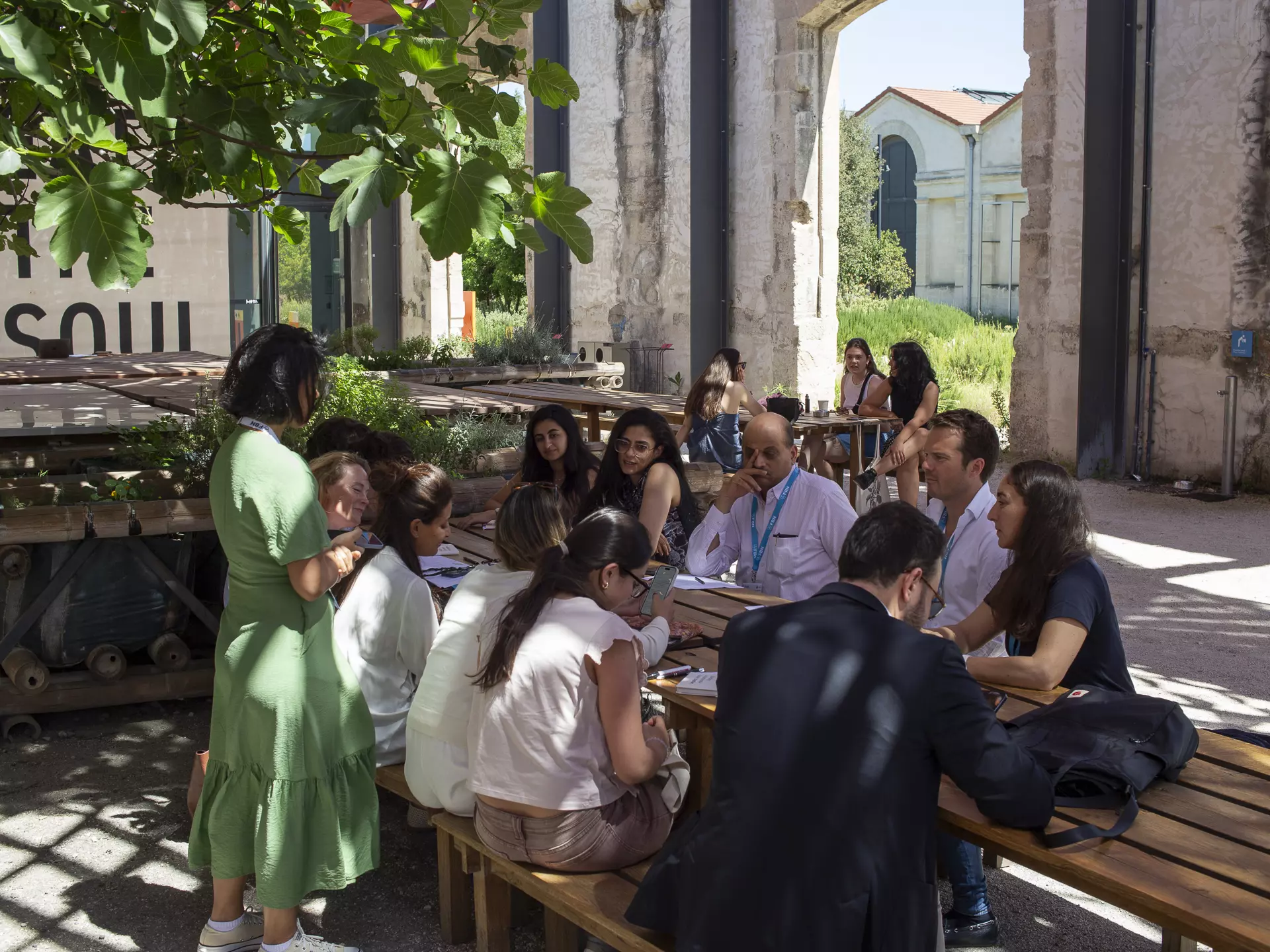
On the evening of 20 May 2026, André Hoffmann and his daughter Isabel gathered a group of people at the Parc des Ateliers in Arles: a seven-hectare former industrial wasteland that has been, over the past two decades, transformed by Maja Hoffmann into one of Europe’s most ambitious cultural campuses. The landscape park, planted where concrete once lay, was in full late-spring bloom.
The fifty or so people who arrived that evening all came from business families, but from very different corners of the world. They each brought a different perspective – as business leaders, entrepreneurs, investors, next-generation family members, philanthropists, and impact practitioners – many of whom had never met before.”What none of them knew yet was that the place itself was already making an argument. The Parc des Ateliers is, at its core, a story of transformation: about what becomes possible when you mobilise heritage to take a landscape defined by extraction towards an ecosystem of regeneration. That argument would only become legible over the two days that followed.
This gathering, the FBN × InTent Impact Action Days, was an attempt to move a group of people who do not naturally act together from conversation to committed, collective action. What happened when they did is what this read is about.
For too long, the sustainability debate has focused on listed corporations, intergovernmental bodies, and philanthropic foundations.
It has largely missed a category of actor that is, structurally well-placed to drive long-term change: the business-owning family. Wealthy individuals, argued the Centre for Sustainable Finance and Private Wealth, are not one-dimensional actors with a chequebook. They carry four distinct forms of capital – economic, social, symbolic and cultural – and the real opportunity lies in deploying them in concert. Money, in other words, is one lever among several. Skills, networks and reputation are the multipliers.
And family businesses, specifically, occupy a structural position that no other category of actor does. They are not answerable to quarterly earnings calls. They do not change strategy with every election cycle. They carry institutional trust – built across generations, embedded in territories – at a time when trust in corporations, governments and media is eroding almost everywhere else. And crucially, they are free to define their own purpose. A listed company’s room for manoeuvre is constrained by its shareholders. A family business can decide, at board level, that the wellbeing of its workers, the health of its land, and the stability of its community are not externalities to be managed but structural foundations of business operations. According to McKinsey, family businesses contribute over 70% of global GDP. The 500 largest alone generate revenues equivalent to the world’s third-largest economy. As FBN’s CEO Alexis du Roy de Blicquy put it at the opening of the Arles event:
“The world out there thinks we are 70% of the problem. Let’s prove to them we can be 70% of the solution.”
So, what is missing? The proof of collective action.
Only 37% of family businesses globally have a defined sustainability strategy. The gap between structural potential and actual practice remains vast. What had never been attempted, until these Impact Action Days in Arles, was putting a critical mass of these actors in a room together to work on an architecture of collaboration. To define, across four areas of shared concern, what they would actually do. Together.
Business families do not naturally act together. This is not a flaw, it is a structural feature. Their privacy is part of what makes them effective. Their independence is what gives them the long time horizons and freedom from institutional pressure that listed corporations rarely enjoy. As Chavalit Frederick Tsao put it at the opening of the event:
“We have more freedom to lead.”
That freedom, however, comes at a cost: the responsibility to coordinate, to disclose, to be held accountable.
This is the paradox at the heart of the family business opportunity. The same structural DNA that makes these actors potentially powerful agents of systemic change (privacy, concentrated control, generational autonomy) also makes them structurally resistant to the one thing systemic change actually requires: collective action. You cannot move a system alone. And yet acting together, for a group of actors whose identity and effectiveness is bound up in independence, is genuinely hard.
And yet, collaboration happens whether they like it or not. Every family business that holds its capital in silos, that acts on its values privately and independently, is already making a choice about which system it is reinforcing. What made these Impact action Days different was not goodwill. It was architecture. Small groups of twelve, diverse enough to create genuine friction across geographies, industries and generations. A strict privacy guarantee, nothing leaving the room without individual approval: that shifted the conversation from performance to honesty. And a format that did not ask participants to agree, but to propose: not “what do we think” but “what could we do together.” Those conditions did not dissolve the resistance to collective action. They made it productive.
The workshop tested whether that resistance could be overcome, and what it would produce if it could. The answer, across four working groups and two days of unscripted conversation, was a shared recognition of where the gaps were and a first set of propositions about what this community might do together that none could do alone.
Jean-Christophe Gaasch offered the governing principle:
“Start with paper planes before you want to go to the moon.”
Start with what is immediately possible. Build trust through small, concrete acts of collaboration. Then scale. In a room of actors who rarely speak this openly to one another, that is where architecture begins.
Biodiversity and Nature restoration
The conversation in this track began with a diagnosis. Philanthropy, impact investing, business and advocacy are typically treated as separate disciplines competing for the same capital. The result is a structural gap – what participants named “the valley of death” – between restoration projects funded by grants and the point at which those same projects become investable. Capital exists across the network. Projects exist. What is missing is the rate at which the two find each other.
The FBN network, it turned out, already holds a partial answer. A decade-old member-led co-investment community has demonstrated that peer-validated, project-to-project intelligence – built on trusted relationships across generations – can move capital faster than any institutional intermediary. The question now is whether the model can be deliberately scaled.
Three workstreams emerged from that recognition.
1. Impact-investing collaboration: structured cross-family deal flow, due diligence and co-investment in biodiversity and ecosystem-services opportunities.
2. Network mapping: a structured picture of who is doing what across the network, organised along ecosystem-service dimensions – the precondition for any serious collective action.
3. Impact safaris: member-hosted visits to landscape-scale projects, beginning with a watershed-restoration programme in the Western Ghats of India, that turn peer learning into direct encounter with what restoration actually looks like on the ground.
Taken together, these are not three separate initiatives. They are three layers of the same infrastructure: know what exists, understand what works, move capital towards it together.
Food systems
The current food was designed to deliver cheap, accessible food at scale – and for decades, by that measure, it succeeded. The problem is that the measure was always too narrow. Opening it to what a food system should achieve today – nourishing people, keeping materials and value in circulation, providing decent livelihoods, and respecting the natural systems it depends on – the current model is failing on almost every count. The pressures converging on it now make the old logic impossible to sustain : Climate change, inflation, shifting diets, demographic change, biodiversity loss and changing attitudes to farming are happening simultaneously, from every direction, dismantling the foundations of high-volume, low-cost food production faster than the system can adapt.
The focus group identified where family businesses, specifically, have the most direct leverage – and where a concrete, collective commitment could shift something real. The answer was closer to home than many expected: the workplace canteen.
The EAT-Lancet Planetary Health Diet is the only available framework that addresses three of the four system goals simultaneously. It is also, in most companies, entirely absent from the daily meal. That gap is where this group chose to act: Planetary Health Canteens, a structured collaboration to develop the principles, measures and standards that normalise planetary-health diets in workplace settings, across family-owned businesses that feed their employees every day.
The approach is deliberately sequential. Survey what educational materials already exist. Identify the gaps. Commission a practical guide for canteen adoption. Design an FBN campaign built around a one-week trial. Then leverage the network’s reach to scale what works.
Decent work and economic growth
Demographic projections show that today’s youngest workers will face dependency ratios double those of previous generations. The cost of supporting those dependants, particularly the elderly, will be far higher than before. Many countries are ageing before they get rich. And the workforce that will need to carry all of this will have to be four to five times more productive than we were.
This structural argument, brought to the room by Andrea Rossi from UNICEF, recasts the question of decent work entirely: not as a compliance obligation or a values statement, but as the precondition for an economy that can actually function in the decades ahead.
What does this mean for business families? As an employer, you are not simply providing a job. You are providing a multiplier, one whose effects ripple outward into a worker’s family, their children’s education, their community’s stability. How much do you know about your present and future workers? Do you know as much about the people who sustain your business as you know about your competitors, your supply chains, your markets?
From that framing, the group built towards two concrete directions. The first is knowledge: a shared intelligence base across geographies, and the beginnings of a family business human flourishing index, a tool that moves beyond GDP to measure what actually matters to the people inside and around these businesses. The second is a pledge: a voluntary statement of shared employer values, written in good times so it can be counted on when crisis hits.
“What you say, in this world, is almost more important than what you do.”
The pledge is where saying and doing begin to converge.
Accelerating impact
Governance delivers impact. The structures and relationships that determine whether a family can actually act together – across generations, across branches, across the competing priorities that any complex family inevitably holds – are what separate an impact aspiration from an impact outcome.
Most participants arrived with impact ideas that looked perfectly feasible on paper. What was holding them back was the conversation that had never taken place to move it forward. Soft governance – the unspoken assumptions, the deferred disagreements, the decisions that feel too difficult to surface in good times – turned out to be the real constraint.
Two observations sharpened the diagnosis.
1. Family cohesion changes over time. What feels natural and unified under a founder often becomes more fragmented as the next generation takes over, because shared purpose, once implicit, needs to be made explicit.
2. Timing matters more than most families acknowledge. Governance works best when it is built during calm, stable periods rather than improvised under the pressure of a crisis that has already arrived.
The group’s working method is straightforward: identify which governance lever requires attention, determine whether the barrier is structural or relational, and apply the appropriate intervention to the appropriate problem. A specific tool supports the diagnostic: the 2035 Letter exercise, in which participants write a letter from nine years in the future and reverse-engineer the conversations that would need to take place now for that letter to be true.
It is a deceptively simple exercise. But it makes the cost of inaction legible, in the most personal terms possible, before the crisis arrives.
FBN Impact Action Days
From pledge to architecture
Systemic change does not emerge from good intentions. It emerges from the moment actors who share a diagnosis begin to share a direction and hold each other to it.
In her closing session, Katell Le Goulven, Strategic Advisor at InTent, named the north star that had emerged across the four tracks:
“A world where business regenerates nature, drives systems-level change and measures success by the wellbeing of all living forms.”
Against that horizon, she identified a model of leadership that the current moment demands and that the room had, over two days, begun to embody. It is not the heroic executive archetype. It is something less visible and multidimensional: relational, collective, adaptive, and grounded in care – for people, for land, for communities, and for oneself.
Her conclusion was unambiguous: the issues on the table – decent work, food systems, biodiversity, impact governance – are by definition global public goods. None of them can be solved by any single actor, however well-capitalised or well-intentioned. They require collective action, and active engagement with the public sector and the policy frameworks that shape the conditions within which businesses operate. A family business that acts on its values in isolation, however admirably, is not moving the system.
A community of family businesses that acts together, with shared definitions, shared metrics and shared accountability, is something different in kind. Market signals strong enough to move sector norms. Common infrastructure that reduces the cost of doing the right thing for everyone. Collective symbolic weight behind policy asks that individual voices cannot sustain alone. This is not more of the same, pooled. It is a different order of force entirely. And it is, structurally, available to this community in a way it is available to almost no other.
That is the architecture Arles began to build.
An open invitation
The Parc des Ateliers was, for decades, a place where things were broken down. Trains were dismantled, metal was processed, industrial material moved through on its way to somewhere else. What stands there now – a campus where art, research and regeneration share the same ground – did not happen by accident. It happened because Maja Hoffmann – André’s sister – decided that what had been extractive could become generative, that the logic of a place is not fixed.
The same choice is available to every business family reading this. The frameworks exist. The shared language – multicapital, nature-positive, systemic investing, human flourishing – is being built and refined. The community is forming. What these first Impact Action Days demonstrated is that when business families move from parallel action to genuine collaboration, something shifts that cannot shift any other way.
And, as Katell le Goulven reminded attendees in her closing remarks, there is no neutral position :
“You are either actively shaping the direction of travel, or passively reinforcing the one already in place.”
FBN is building collaborative workstreams across eight areas where family businesses have direct leverage and systemic reach: biodiversity and nature restoration, circular economy, decent work and economic growth, energy transition, food systems, oceans, and health access and innovation. If your family business or organisation is ready to move from individual action to collective impact on any of these themes, the community is open.
Get in touch with Jenaan Lilani, Head of impact at FBN.


Partners

Stay updated
Register to InTent newsletter to stay informed on our programmes, events and latest news